Research archive
20M training-recipe benchmark
Archived reference. Read the current results →
Historical report; retained as an experimental record.
Historical report. Settings and conclusions describe the recorded experiment. See the current documentation for maintained guidance.
Measured on 2026-09-09: 324 successful runs, covering 108 LR/beta2
combinations across synchronous, packed-4, and packed-8 training. Each
combination uses runtime seeds 42, 43, and 44. The final audit verified full
validation, the saved recipes, and one final.pt per successful run.
Best tested recipes
Selection minimizes mean final-checkpoint full C4 validation cross-entropy (nats) across the three seeds, separately for each mode. The reported uncertainty is the sample standard deviation, not a confidence interval. Combinations must have all three seeds; exact ties favor lower LR, then lower beta2.
| Mode | LR | Beta2 | Mean loss | Sample SD | Configuration |
|---|---|---|---|---|---|
| Synchronous | 0.0028 | 0.999 | 3.564370 | 0.003590 | YAML |
| Packed-4 | 0.0048 | 0.999 | 3.587822 | 0.006839 | YAML |
| Packed-8 | 0.0052 | 0.999 | 3.624001 | 0.011932 | YAML |
The synchronous and packed-4 winners lie inside their searched LR ranges. Packed-8 still selects the largest tested LR, so this grid does not locate its upper optimum. Synchronous LR 0.0028 beats LR 0.0022 by only 0.000135 nats; packed-8 LR 0.0052 beats LR 0.0048 by 0.001538 nats. Both differences are small relative to the observed seed variation. The rankings alone do not establish statistically reliable improvements.
These configurations record the 32,768-token-batch benchmark. This campaign left preset optimizer settings unchanged at the time. The synchronous 20M preset now uses the 128K-token sweep winner. The packed-4 preset now uses its own 128K-token exponential-topology winner. The earlier single-seed, multi-size campaign is reported separately in campaign_results.md.
Search grid and fixed settings
| Mode | Learning rates | Beta2 | Seeds | Runs |
|---|---|---|---|---|
| Synchronous | 0.0008, 0.0010, 0.0012, 0.0014, 0.0016, 0.0018, 0.0020, 0.0022, 0.0024, 0.0026, 0.0028, 0.0030 | 0.95, 0.98, 0.999 | 42, 43, 44 | 108 |
| Packed-4 | 0.0010, 0.0012, 0.0016, 0.0020, 0.0024, 0.0028, 0.0032, 0.0036, 0.0040, 0.0044, 0.0048, 0.0052 | 0.95, 0.98, 0.999 | 42, 43, 44 | 108 |
| Packed-8 | 0.0010, 0.0012, 0.0016, 0.0020, 0.0024, 0.0028, 0.0032, 0.0036, 0.0040, 0.0044, 0.0048, 0.0052 | 0.95, 0.98, 0.999 | 42, 43, 44 | 108 |
The initial 108-run grid was extended four times by 54 runs. Completed experiments were reused, with their artifacts unchanged. Every extension used the original frozen trainer and inherited the saved configuration, changing only LR and the output directory. The final extension reused 270 completed runs.
All runs use the 20,403,520-parameter model (per local model in packed training):
eight layers, width 320, five heads, FFN width 896, vocabulary 32,000, and context
length 1,024. AdamW uses beta1 0.9,
epsilon 1e-8, weight decay 0.1, and gradient clipping at 1.0. The schedule has
5% linear warmup followed by cosine decay to 10% of peak LR. Training uses BF16
autocast, compilation, SDPA attention, fused AdamW, and deterministic=false.
| Mode | Local models | Microbatch sequences per model | Global batch tokens | Virtual epochs | Training targets |
|---|---|---|---|---|---|
| Synchronous | 1 | 32 | 32,768 | 40 | 408,071,168 |
| Packed-4 | 4 | 8 | 32,768 | 40 | 408,068,096 |
| Packed-8 | 8 | 4 | 32,768 | 40 | 408,068,096 |
Packed training uses one-peer ring topology with local optimizer states. Evaluation uses the global parameter average. Each job runs on one NVIDIA GH200 120GB, so the packed modes simulate decentralized training on one GPU; these measurements do not include physical network costs. The Slurm campaign allowed 40 concurrent jobs with a 30-minute limit per job. The recorded software environment is Python 3.12.13, PyTorch 2.14.0, and CUDA 13.0.
Data, evaluation, and checkpoint retention
All runs use the same prepared allenai/c4 cache and TinyLlama tokenizer.
Preprocessing shuffle seed 42 and validation seed 12345 remain fixed while
runtime.seed varies. Dataset and tokenizer revisions and cache identity are
retained in results.json and the selected YAMLs.
Each final checkpoint is evaluated over the same 197,411,295 C4 validation prediction targets. Epoch evaluations use a fixed 1,024-block subset and continue to record best-loss statistics. Selection uses the final full-validation loss, rather than the best intermediate subset loss. Validation is also used for selection; there is no independent test-set estimate in this benchmark.
All runs use training.checkpoint_policy: final: only final.pt is retained,
with no periodic, epoch, worker-weight, or interruption checkpoint exports.
Packed final checkpoints retain every local model and optimizer state and
support evaluation of averaged weights. best.json contains subset statistics
with weights: null. Failed attempts and logs from earlier submissions remain
in the local campaign archive; they are not additional experimental seeds.
Learning-rate response at beta2 = 0.999
Each cell is mean final full-validation loss ± sample SD over three seeds. A dash denotes an LR that was not tested in that mode. Results for every beta2 are in the 108-row summary CSV.
| LR | Synchronous | Packed-4 | Packed-8 |
|---|---|---|---|
| 0.0008 | 3.588713 ± 0.007140 | — | — |
| 0.0010 | 3.581478 ± 0.006324 | 3.634579 ± 0.003744 | 3.710819 ± 0.006792 |
| 0.0012 | 3.569573 ± 0.002860 | 3.620119 ± 0.006653 | 3.689397 ± 0.006961 |
| 0.0014 | 3.566896 ± 0.002125 | — | — |
| 0.0016 | 3.570824 ± 0.004557 | 3.606654 ± 0.001872 | 3.666961 ± 0.007703 |
| 0.0018 | 3.566512 ± 0.008356 | — | — |
| 0.0020 | 3.568652 ± 0.007927 | 3.595806 ± 0.003967 | 3.660161 ± 0.004760 |
| 0.0022 | 3.564505 ± 0.007247 | — | — |
| 0.0024 | 3.565026 ± 0.006815 | 3.596458 ± 0.003870 | 3.653890 ± 0.001180 |
| 0.0026 | 3.566678 ± 0.005947 | — | — |
| 0.0028 | 3.564370 ± 0.003590 | 3.593501 ± 0.000826 | 3.646855 ± 0.007799 |
| 0.0030 | 3.572076 ± 0.004650 | — | — |
| 0.0032 | — | 3.593771 ± 0.012870 | 3.647980 ± 0.012512 |
| 0.0036 | — | 3.591065 ± 0.006906 | 3.638749 ± 0.012406 |
| 0.0040 | — | 3.593467 ± 0.003287 | 3.632477 ± 0.008548 |
| 0.0044 | — | 3.593090 ± 0.001265 | 3.632167 ± 0.004848 |
| 0.0048 | — | 3.587822 ± 0.006839 | 3.625539 ± 0.006993 |
| 0.0052 | — | 3.591678 ± 0.004363 | 3.624001 ± 0.011932 |
Plots and complete results
- Full-grid heatmaps: PDF, PNG. The full-size files show all 12 LRs per mode.
- Winning validation curves: PDF, PNG, curve data.
- Per-run CSV: 324 final-validation results.
- Grouped CSV: 108 complete combinations and ranks.
- JSON results and provenance: exact per-run and grouped values, selections, grid, seeds, revisions, environment, and job IDs.

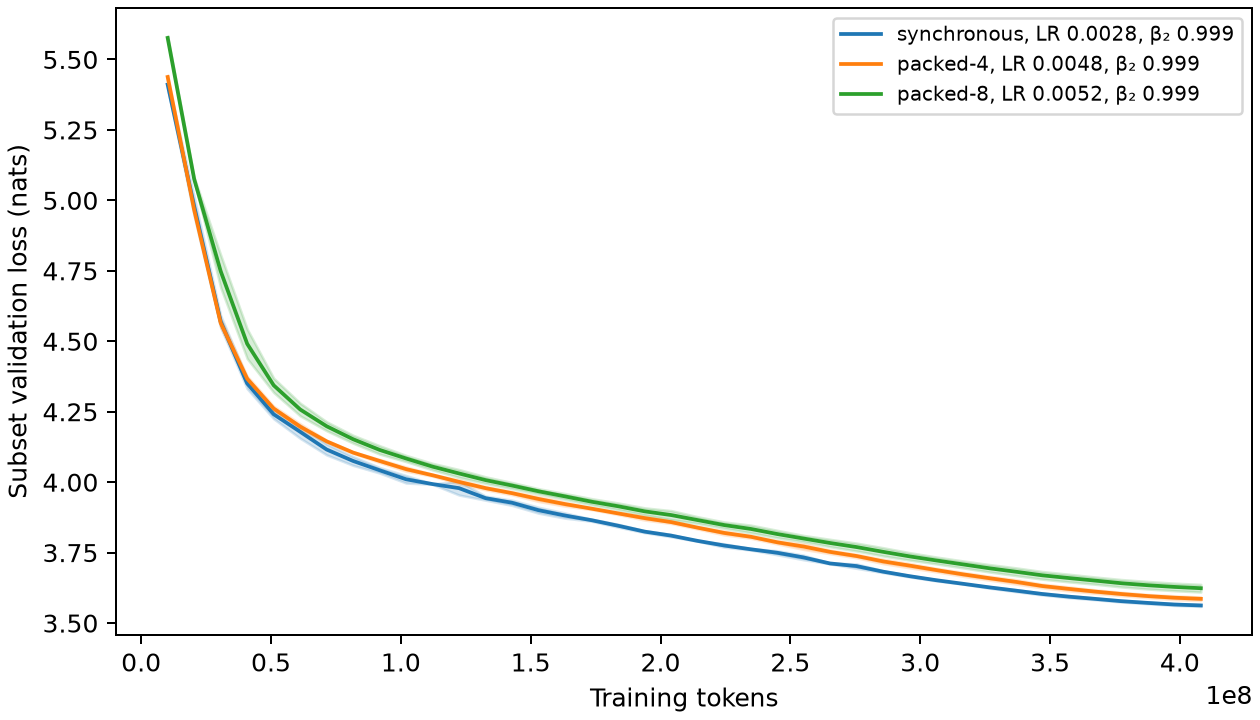
The curves plot epoch subset-validation loss, with a mean line and a band of ± one sample SD across seeds. Their points are not the full-validation values used to rank the recipes above.
Reproduction and provenance
The selected YAMLs preserve the measured settings and pinned data revisions,
with data.cache_dir changed to data/c4 and output directories made relative
to the repository. Prepare the cache as described in the README,
then use the standard training command, for example:
uv run tiny-llm train --config doc/data/recipe_sweep_20m/selected-synchronous.yaml \
  --set runtime.seed=42 --set runtime.output_dir=runs/20m-selected-synchronous-seed42
Use the corresponding packed YAML for four or eight local models. Repeat with
seeds 43 and 44 in separate output directories to match the three-seed protocol.
deterministic=false means these recipes do not promise bitwise reproduction.
The sweep-specific orchestration was removed from the main source package;
these configurations use the regular training entrypoint.
The local runs/recipe-sweep-20m archive contains the frozen training source,
resolved configurations, checkpoints, metrics, submission receipts, failed logs,
previous reports, and removed sweep tools. The per-run CSV’s directory field
is relative to that archive. Large training artifacts are gitignored; the
results and plots linked here are committed documentation.
The original training source hash is
846d7aa92b4eb968891e84bbfa2a205ab899f28a437be1fa81dfe08c8cfc8dd3.
Cache identity is
8cf0c4883c19d26f378623f91bfe079bc8ebf8f23e51814821f4c8c28c4b8151.
The final audit checked all 324 successful results, recipe settings, complete
validation, final-only checkpoint retention, all grouped means and sample SDs,
and the selected configurations. The final 54-run extension left the prior 270
run records and 1,080 tracked run artifacts unchanged.